

Family Health Unit Canelas, Local Health Unit Gaia, Espinho, Portugal.
Family Health Unit Canelas, Local Health Unit Gaia, Espinho, Portugal.
Email: joanacreis18@gmail.com
Received : October 20, 2025,
Accepted : November 07, 2025
Published : November 28, 2025,
Archived : www.jclinmedcasereports.com
This case highlights the importance of vaccination against Varicella Zoster in young adults, the timely initiation of antiviral therapy, and health education regarding self-medication and recognition of alarm signs. We present the case of a 22-year-old male with no prior history of Varicella Zoster infection, who presented to the emergency department with high fever and generalized and exuberant vesicular exanthema. Treatment with acyclovir, paracetamol, and metamizole was initiated. Three days later, he returned due to worsening of the rash, maintaining clinical stability. Chickenpox is a primary infection caused by the Varicella Zoster virus, usually self-limited in childhood but potentially severe in non-immunized adults. Vaccination has shown high efficacy in preventing the disease and its complications and is recommended for susceptible adolescents and adults.
Keywords: Chickenpox; Exanthema; Adult; Immunization.
Copy right Statement: Content published in the journal follows Creative Commons Attribution License (http://creativecommons.org/licenses/by/4.0). © Reis JC (2025)
Journal: Open Journal of Clinical and Medical Case Reports is an international, open access, peer reviewed Journal mainly focused exclusively on the medical and clinical case reports.
Chickenpox is an infectious disease caused by the Varicella Zoster Virus (VZV), one of the eight known human-infecting herpesviruses. VZV infection manifests in two clinically distinct forms: chickenpox (primary infection) and herpes zoster (viral reactivation) [1].
Primary VZV infection is more common in childhood, typically presenting as a mild and self-limiting illness. In contrast, adult cases are less frequent but tend to be more severe [1]. Mortality from chickenpox in adults is estimated to be up to twenty times higher than in children, particularly among individuals aged 15 to 44 years [2].
Clinically, the disease begins with fever, malaise, and loss of appetite, followed by the onset of a pruritic skin rash that evolves over several days. Patients may present with macules, papules, vesicles, pustules, and crusts, often simultaneously, distributed across the face, trunk, and extremities [1,3].
The average incubation period is 14 to 16 days, although it may range from 10 to 21 days [1,3]. Transmission occurs via direct contact with lesions or contaminated objects, as well as through airborne respiratory droplets expelled when an infected individual sneezes, coughs, or speaks [3]. The contagious period spans from 2 days before the rash appears until all lesions have crusted over [1].
Treatment is primarily symptomatic, involving antipyretics and antihistamines. However, in cases with severe symptoms or high risk of complications—such as pregnant women, adolescents, unvaccinated adults, or immunocompromised individuals—oral antiviral therapy with valacyclovir or acyclovir is recommended. Ideally, these medications should be initiated within 24 hours of rash onset [4].
Although complications are relatively uncommon, they may include bacterial superinfection (particularly by Group A Streptococcus), encephalitis, Reye’s syndrome, and pneumonia [1].
Several studies have shown that immunization against VZV not only reduces the incidence of chickenpox in pediatric populations but also decreases disease severity and transmission risk in cases of infection. Nevertheless, unvaccinated adults without a known history of prior infection remain susceptible [2,5]. In Portugal, vaccination is recommended for susceptible adolescents (aged 11-13 years) and adults, administered in two doses spaced 4 to 8 weeks apart. High-risk groups include: non-immune women prior to pregnancy, unvaccinated parents of young children, individuals in regular contact with immunocompromised patients, and non-immune individuals in high-risk occupations (e.g., daycare workers, teachers, and healthcare professionals) [2].
A 22-year-old male patient, autonomous and cognitively intact, presented to the emergency department on June 15, 2025, with a fever that began the previous night, reaching a maximum axillary temperature of 40°C. The fever was unresponsive to alternating doses of paracetamol 1 g and ibuprofen 600 mg, which he had initiated on his own. Additionally, he reported a generalized vesicular rash with the same duration of evolution. He mentioned that a few days earlier, he and his sister had been in contact with a child diagnosed with chickenpox during a family gathering, and that his sister was experiencing similar symptoms. He denied any previous history of Varicella Zoster infection.
The patient had a past medical history of celiac disease and total thyroidectomy in 2017 due to papillary thyroid carcinoma. His regular medication included levothyroxine 0.1 mg. He had no known drug allergies and his National Vaccination Plan was up to date, although he had not been vaccinated against Varicella Zoster Virus.
On physical examination in the emergency department, he was conscious, cooperative, and oriented, with well-perfused and hydrated mucous membranes, and no jaundice. A widespread vesicular rash was observed across the body. He was eupneic at rest, with no signs of respiratory distress. Blood pressure was 140/73 mmHg, heart rate 88 bpm, oxygen saturation 99% on room air, and tympanic temperature 40.1°C. Pulmonary auscultation revealed symmetrical vesicular breath sounds without adventitious noises. Cardiac auscultation showed rhythmic heart sounds without audible murmurs.
A diagnosis of primary Varicella Zoster infection was established. Given the hemodynamic stability and the stage of disease progression, treatment was initiated with oral acyclovir 800 mg and intravenous metamizole 2. The patient remained under observation for approximately one hour.
Upon medical reassessment, he reported symptomatic improvement, with a reduction in tympanic temperature to 38°C. He was discharged home with instructions to discontinue ibuprofen and begin symptomatic treatment with paracetamol 1 g and metamizole 575 mg as needed for 5 days, along with targeted antiviral therapy with acyclovir 800 mg every 4 hours for 7 days. He was also advised to maintain contact isolation for at least 5 days and until all lesions had crusted over. Warning signs that should prompt medical reassessment were explained.
On June 18, 2025, the patient returned to the walk-in clinic due to significant worsening of the rash, with the appearance of multiple new lesions across the body. He had been afebrile for 2 days and was adhering to treatment with acyclovir 800 mg, paracetamol 1 g, and metamizole 575 mg.
On examination, he was conscious, cooperative, and oriented, with well-perfused and hydrated mucous membranes, and no jaundice. Multiple large papules, vesicles, and crusts were observed across the body, predominantly affecting the face, trunk, and upper limbs, with no apparent signs of bacterial superinfection (Figures 1, 2, & 3). He was eupneic at rest, with no signs of respiratory distress. Blood pressure was 123/76 mmHg, heart rate 79 bpm, oxygen saturation 99% on room air, and tympanic temperature 37.1°C. Pulmonary auscultation revealed symmetrical vesicular breath sounds without adventitious noises. Cardiac auscultation showed rhythmic heart sounds without audible murmurs.
Given the clinical stability and apparent absence of complications, particularly bacterial superinfection, the patient was discharged from the clinic with instructions to continue acyclovir 800 mg and paracetamol 1 g as needed. Warning signs that should prompt medical reassessment were reiterated: persistent fever, localized and intense pain, signs of infection in skin lesions, altered mental status, or respiratory difficulty.
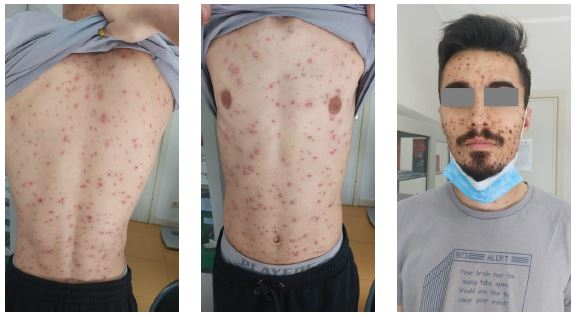
This case involves a young, immunocompetent male who presented with sudden-onset high-grade fever and a generalized vesicular exanthem—findings consistent with a primary Varicella Zoster Virus (VZV) infection. The diagnosis was clinical, supported by the typical morphology of the lesions (papules, vesicles, and crusts at various stages of evolution) and the absence of prior vaccination. Given the classic presentation and lack of systemic involvement, additional diagnostic tests were deemed unnecessary.
The decision to initiate oral antiviral therapy with acyclovir 800 mg was appropriate, considering its early administration (<24 hours), the severity of the rash, and the high fever. The aim of this treatment was to reduce symptom duration, lesion severity, and the risk of complications.
Conversely, the patient’s self-administration of ibuprofen represents a critical point in this case. Current evidence suggests a potential association between the use of non-steroidal anti-inflammatory drugs (NSAIDs) in patients with VZV infection and an increased risk of bacterial superinfection. Therefore, NSAID use is generally discouraged in these patients. Nonetheless, NSAID intake does not appear to be directly linked to exacerbation of cutaneous lesions [6].
Accordingly, discontinuation of ibuprofen and the use of metamizole and paracetamol as needed were appropriate measures, based on the patient’s stable clinical course and absence of complications. Reinforcing patient education regarding warning signs was also crucial, as it facilitated better symptom management at home.
Although chickenpox is typically a self-limiting childhood illness, it carries significant clinical relevance when occurring in adults, particularly in unvaccinated individuals such as this patient, due to the severity of symptoms and risk of complications. This case therefore underscores the importance of promoting Varicella Zoster Virus vaccination among young adults. One suggestion would be to assess, during routine consultations at ages 12 or 13, whether adolescents have a history of prior VZV infection and, if not, offer vaccination.
In summary, this case highlights the importance of patient education, particularly regarding self-medication and monitoring for warning signs. It also emphasizes both the value of vaccination as a preventive measure and the importance of early antiviral therapy initiation in young adults infected with Varicella Zoster Virus.