

1General Medicine Practitioner, University of Pamplona, Norte de Santander, Colombia.
2Biologist, Universidad Industrial de Santander, Bucaramanga, Santander, Colombia.
3General Medicine Practitioner and Primary Care, Los Comuneros Hospital Universitario de Bucaramanga, Santander, University of Pamplona, Norte de Santander, Colombia.
General Medicine Practitioner and Primary Care, Los Comuneros University Hospital of Bucaramanga, Santander, Universidad de Pamplona, Norte de Santander, Colombia.
Email: mduran194@unab.edu.co
Received : October 01, 2025,
Accepted : November 04, 2025
Published : November 28, 2025,
Archived : www.jclinmedcasereports.com
Introduction: Skin cancer is among the most common human neoplasms. It usually arises in areas exposed to ultraviolet radiation; however, its occurrence in non-exposed regions is associated with other etiological agents, such as HPV.
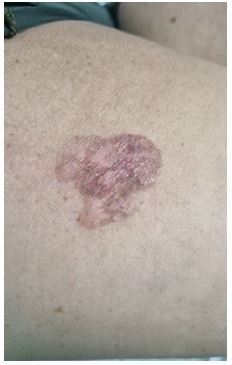
Clinical findings: An 83-year-old male presented with an 8-year history of a patch-like, flat lesion located on the external surface of the proximal third of the right thigh. The lesion measured approximately 3×3 cm, exhibited irregular borders, heterogeneous reddish-brown pigmentation, and mild scaling. Diagnosis, interventions, and outcomes: A diagnosis of Bowen’s disease was established. Wide local excision of the lesion was performed, resulting in complete remission.
Conclusion: Early detection of skin cancer in primary care, even in anatomically unusual locations, is essential to optimize clinical outcomes and prevent complications associated with Bowen’s disease.
Keywords: Skin cancer; Bowen’s disease; Older adult; HPV; Case report.
Abbreviations: HPV: Human Papilloma Virus; NMSC: Non-Melanoma Skin Cancers; BCC: Basal Cell Carcinoma; SCC: Squamous Cell Carcinoma; BD: Bowen’s Disease; UVR: Ultraviolet Radiation.
Copy right Statement: Content published in the journal follows Creative Commons Attribution License (http://creativecommons.org/licenses/by/4.0). © Patino MAD (2025)
Journal: Open Journal of Clinical and Medical Case Reports is an international, open access, peer reviewed Journal mainly focused exclusively on the medical and clinical case reports.
Skin cancer is one of the most prevalent malignancies worldwide. It is traditionally classified according to histological features into NMSC, including basal BCC and SCC, and melanoma. SCC in situ is also referred to as BD. The primary risk factor is UVR exposure; nevertheless, genetic and infectious factors have also been implicated [1].
In 2022, a total of 19,976,499 new cancer cases were reported globally. Of these, 6.2% corresponded to NMSC and 1.7% to melanoma, with a male-to-female ratio of 3:2 [2]. In Colombia, during the same period, 58,813 new cases of all cancer types were documented, of which 19.4% were NMSC (14.7% BCC, 3.5% SCC, and 1.2% unspecified) and 1.1% melanoma. The overall mortality rates were 5.72 and 0.79 per 100,000 inhabitants, respectively, underscoring the significant public health burden of this condition [3].
SCC most commonly arises in sun-exposed areas such as the face and distal extremities, whereas BCC may develop in both photo-exposed and less exposed regions, such as the trunk. The thigh represents an uncommon anatomical site for both, and a rare site for BD [4]. Its proximity to the inguinal lymph node chain and the fact that it is infrequently examined in routine clinical practice increase the diagnostic challenge. Within this context, we report the case of an older adult with a large BD lesion located on the proximal third of the right thigh.
An 83-year-old male, born and residing in Bucaramanga, unemployed, with a medical history of primary hypertension, primary hypothyroidism, and benign prostatic hyperplasia, presented in 2023 to his primary care physician with a cutaneous lesion described as a “spot” on the right thigh. The lesion had been present for 8 years, had enlarged over the past year, become pruritic, and changed in coloration. During this period, the patient had self-medicated with topical corticosteroids and clotrimazole without improvement.
On physical examination, a fair-skinned older adult was noted to have a flat, patch-like lesion measuring approximately 3×3 cm on the external surface of the proximal third of the right thigh. The lesion showed irregular borders, heterogeneous reddish-brown pigmentation, and mild scaling (Figure 1). No inguinal or popliteal lymphadenopathy was palpable, and no mucosal, genital, or additional cutaneous lesions were observed. He was referred to dermatology, where SCC was suspected, and a biopsy was performed. Histopathology confirmed SCC in situ (BD) with involvement of the lateral margins. The patient was subsequently referred to plastic surgery, where a wide local excision was carried out. The final pathology report demonstrated SCC in situ with clear margins. The patient remains under quarterly clinical follow-up with photoprotection. No metastases or perilesional lymphadenopathy were documented.
SCC in situ is characterized by disordered proliferation of keratinocytes confined to the epidermis, with BD representing one of its most frequent clinical variants. Although UV radiation is the principal risk factor, additional contributors include advanced age, HPV infection, immunosuppression, and certain medications, all of which may favor its occurrence in uncommon anatomical sites [5]. This case highlights such an unusual location, likely related to age and HPV infection, which, although not confirmed in this patient through laboratory testing, is known to be highly prevalent and underdiagnosed in males [6].
In primary care, the early recognition of cutaneous lesions such as BD is essential to prevent progression to invasive forms and to differentiate them from other skin cancers. The fact that this lesion remained undiagnosed for approximately eight years emphasizes the importance of timely diagnosis. Moreover, the lesion’s large size and proximity to a lymph node chain constituted significant risk factors for potential invasion and dissemination [7]. This underscores the need for thorough skin examinations and highlights the crucial role of comprehensive clinical evaluation in preventing serious complications. The patient’s self-medication with corticosteroids and antifungals, without success, further illustrates the lack of recognition of the lesion’s neoplastic nature, contributing to diagnostic delay.
The management of BD in this case consisted of wide surgical excision, an approach consistent with international guidelines [8].
This case underscores the importance of considering skin cancer in anatomically unusual locations. Early detection in primary care, combined with an appropriate multidisciplinary approach, is fundamental to improving clinical outcomes and preventing complications associated with Bowen’s disease.
Acknowledgements: To the patient and his family.