

Capitol Technology University, Laurel Maryland, USA.
Capitol Technology University, Laurel Maryland, USA.
Email: djlbradley@yahoo.com
Received : February 27, 2025,
Accepted : March 25, 2025
Published : March 28, 2025,
Archived : www.jclinmedcasereports.com
Pain, whether physical, emotional, or psychological, behaves like energy—it can be absorbed, reflected, or transferred by individuals and systems. The Theory of Pain Absorption and Transfer introduces a thermodynamic model of pain, proposing that pain absorptive power determines how much pain an individual internalizes versus reflects. This theory applies scientific principles of heat absorption and transfer to pain, offering a measurable framework to quantify and manage suffering. Through an interdisciplinary literature content analysis, this paper explores the applicability of the theory across psychology, physiology, neuroscience, social dynamics, trauma studies, and pain management. Findings suggest that pain absorption is governed by intrinsic and extrinsic properties, including biological, psychological, and environmental factors, influencing resilience, trauma processing, and interpersonal pain transmission. Understanding these mechanisms can advance clinical interventions, mental health strategies, and social support systems, potentially leading to new therapeutic models and pain management techniques.
Keywords: Pain absorption; Pain transfer; Pain modulation; Psychological resilience and pain; Neural pathways of pain; Empathy circuits and pain; Vicarious trauma and pain; Intergenerational trauma; Chronic pain management; Non-pharmacological pain treatments.
Copy right Statement: Content published in the journal follows Creative Commons Attribution License (http://creativecommons.org/licenses/by/4.0). © DeAnjelo Bradley (2025)
Journal: Open Journal of Clinical and Medical Case Reports is an international, open access, peer reviewed Journal mainly focused exclusively on the medical and clinical case reports.
Despite advancements in pain research, the mechanisms of pain absorption and transfer remain underexplored. Existing models such as the Gate Control Theory of Pain [4] and the Biopsychosocial Model [2] provide valuable insights into pain perception and modulation, yet they fail to address the dynamics of pain absorption, emission, and interpersonal transfer. Without a quantifiable framework to measure how pain is internalized or deflected, clinicians and researchers lack a structured approach to mitigating excessive pain absorption and its long-term consequences.
Furthermore, current research on vicarious trauma, intergenerational pain transfer, and social pain contagion suggests that pain is not confined to the individual but is shared across interpersonal and systemic networks [9,11]. However, there is no standardized method to assess pain absorption power (aπ) or develop targeted interventions based on individual resilience, vulnerability, or physiological pain processing capacity.
systemic networks [9,11]. However, there is no standardized method to assess pain absorption power (aπ) or develop targeted interventions based on individual resilience, vulnerability, or physiological pain processing capacity.
Evidence
Scientific research supports the modulation of pain absorption across psychological, physiological, and social domains [3,9]. This paper examines six key focus areas—psychology, physiology, neuroscience, social dynamics, trauma studies, and pain management—to analyze pain absorption and transfer mechanisms across disciplines.
Pain absorptive power
The absorptive power of pain (aπ) is defined as the ratio of pain absorbed (πa) to total incident pain (πi) over time:
aπ=πaπia_{\pi} = \frac{\pi_a}{\pi_i}
where:
aπ = Pain absorptive power (dimensionless)
πa = Absorbed pain (measured unit)
πi = Total pain experienced
Individuals with high pain absorptive power tend to internalize pain, leading to higher emotional distress, chronic stress, and trauma susceptibility. In contrast, low pain absorptive individuals deflect more pain, which may result in emotional resilience or externalized pain expression.
Pain transfer and reflection
Pain is not contained within individuals—it transfers between people and systems based on interaction dynamics:
πi=πa+πr\pi_i = \pi_a + \pi_r
where:
πi = Total incident pain
πa = Absorbed pain
πr = Reflected pain
Understanding pain reflection and emission can optimize pain mitigation strategies, emotional resilience, and trauma recovery.
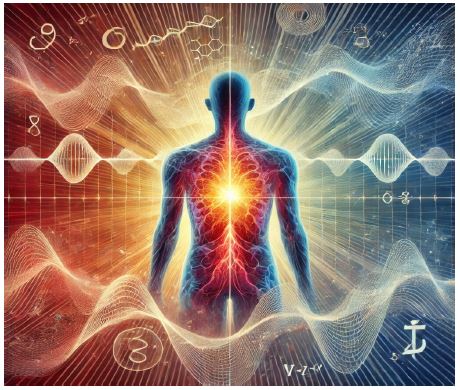
Main idea: Psychological resilience influences pain absorption, determining whether an individual internalizes or reflects pain.
Evidence: A study on rheumatoid arthritis patients found that psychological resilience mitigates pain-related anxiety and depression [5].
Pain catastrophizing increases pain absorption, while acceptance strategies promote emotional regulation and pain deflection [6].
Analysis: Resilience functions as a reflective barrier, reducing pain absorption and improving coping mechanisms.
Link back: Resilience training and CBT interventions could be tailored to alter pain absorption dynamics, reducing maladaptive internalization of suffering.
Main idea: Pain absorption is influenced by biological factors, including pain threshold, neurochemical regulation, and inflammatory response.
Evidence: A 2024 meta-analysis found that athletes have higher pain tolerance and report lower pain intensity [6].
Fibromyalgia patients exhibit heightened pain absorption, indicating impaired endogenous pain modulation [8].
Analysis: Pain tolerance modulates absorptive power, with biological mechanisms determining pain processing efficiency.
Link back: Future research could explore biomarkers of pain absorption to develop personalized pain management therapies.
Main idea: Pain can be socially transferred through neural circuits governing empathy and emotional contagion.
Evidence: fMRI studies show that observing another in pain activates the same neural pathways involved in first-hand pain processing [9].
Rodent studies confirm that pain can be socially transmitted, with mice exhibiting pain behaviors after observing a distressed peer [10].
Analysis: Pain transfer operates at a neurological level, suggesting a biological basis for vicarious trauma and shared suffering.
Link back: Therapeutic interventions could leverage neural mechanisms of pain transfer to reduce maladaptive absorption while enhancing resilience.
Main idea: Pain is transferred across generations and social groups, influencing mental health outcomes over time.
Evidence: Vicarious trauma research reveals that therapists and caregivers absorb patient distress, leading to PTSD-like symptoms (Cleveland Clinic, 2023).
Intergenerational trauma studies demonstrate that stress-induced epigenetic changes are inherited, affecting descendants’ psychological health (Cambridge, 2024).
Analysis: Pain can accumulate across generations, necessitating strategies to disrupt trauma transmission.
Link back: Trauma-focused therapies and resilience training can intervene in intergenerational pain absorption cycles.
Main idea: Modern pain management incorporates pain absorption principles, leveraging psychological and neurological strategies.
Evidence: Empathic patient-centered care improves pain outcomes, demonstrating that supportive interactions reduce pain absorption (PMC, 2023).
Cognitive-Behavioral Therapy (CBT), mindfulness, and virtual reality therapy help modulate pain absorption and deflection [7].
Analysis: Non-pharmacological pain management strategies can be optimized based on an individual’s pain absorptive profile.
Link back: The Theory of Pain Absorption and Transfer can refine clinical interventions, enhancing long-term pain relief and emotional well-being.
Methodology
This study employs a qualitative content analysis approach to examine the Theory of Pain Absorption and Transfer through an interdisciplinary literature review. The research synthesizes peer-reviewed studies from psychology, neuroscience, physiology, trauma studies, social sciences, and clinical pain management to establish a theoretical framework for understanding pain absorption, transfer, and mitigation strategies.
The research findings highlights:
1. Pain absorption follows measurable principles similar to energy absorption in thermodynamics.
2. Resilience, vulnerability, and neural mechanisms influence pain transfer and modulation.
3. Social and intergenerational pain transfer occurs through neural empathy circuits and epigenetic inheritance.
4. Proactive interventions, such as psychological resilience training, cognitive reframing, and structured social support, reduce maladaptive pain absorption.
5. Pain management can be improved by tailoring treatments to an individual’s absorptive capacity.
Interpretation of results
Proactive measures, such as resilience training, structured social support, and therapeutic interventions, significantly impact how pain is absorbed or deflected. The study suggests that individuals with higher resilience and lower absorptive power experience less emotional burden, leading to improved psychological well-being.
Comparison with previous studies
These findings align with prior research on neural pain modulation and psychological trauma resilience. Studies on intergenerational trauma [11] and pain perception [9] support the idea that pain can be transferred and absorbed differently based on personal and environmental factors.
Implications of findings
By quantifying pain absorption and transfer, clinicians and researchers can develop customized interventions for chronic pain patients, trauma survivors, and individuals in high-stress environments. This model could influence mental health policies, pain management strategies, and organizational well-being initiatives.
Limitations of the study
This study relies on existing literature and does not collect primary data. Additionally, pain absorptive power remains a theoretical construct requiring empirical validation. The study may also not fully capture real-time workplace or clinical pain dynamics.
Pain is not solely an internalized experience—it is a transferable entity governed by measurable absorption and reflection principles. By integrating psychological, physiological, and social research, the Theory of Pain Absorption and Transfer provides a new paradigm for understanding and managing pain. Future research should focus on quantifying pain absorption, developing personalized interventions, and refining therapeutic models. Understanding these dynamics could transform pain science, trauma therapy, and resilience-building strategies.
Recommendations for future research
Based on the findings of this study, several areas warrant further investigation to enhance the Theory of Pain Absorption and Transfer and its application in pain management, psychological resilience, and trauma mitigation.
Quantifying Pain Absorptive Power (aπ) and its Measurement in Clinical Settings
• Future research should develop empirical methods to quantify pain absorptive power, similar to how thermal conductivity is measured in physics.
• Neuroimaging techniques (fMRI, PET scans) could be used to observe neural pain absorption patterns.
• Physiological markers (cortisol levels, heart rate variability, inflammatory response) could be tested as biological correlates of pain absorption.
• Longitudinal studies on psychological resilience and pain absorption
• Conduct long-term studies on individuals with high and low pain absorptive power to determine how resilience training influences pain processing over time.
• Investigate the role of Cognitive-Behavioral Therapy (CBT), mindfulness, and stress management techniques in reducing maladaptive pain absorption.
• Exploring pain transfer in social and workplace settings
• Research how pain contagion spreads in high-stress environments, such as healthcare, emergency response, and military settings.
• Study how supportive workplace policies (mental health programs, burnout prevention, trauma-informed leadership) influence pain absorption and resilience.
• Investigate the effectiveness of peer support groups and mentorship in reducing vicarious trauma absorption in professionals exposed to secondary trauma.
• The role of cultural and societal factors in pain absorption and transfer
• Study how cultural attitudes toward pain (stoicism vs. emotional expression) influence absorptive power across populations.
• Explore how intergenerational trauma absorption differs across ethnic, religious, and socio-economic groups.
• Investigate cultural healing practices (meditation, community rituals, narrative therapy) in pain transfer mitigation.
• Development of non-pharmacological interventions based on pain absorption theory
• Design customized interventions based on an individual’s pain absorption profile (e.g., resilient vs. high-absorptive individuals).
• Develop AI-driven pain tracking and self-assessment tools that monitor psychological and physiological responses to pain over time.
• Study the efficacy of biofeedback, virtual reality therapy, and neurostimulation in modulating pain absorptive capacity.